
Nature
Nature, in the broadest sense, is the natural, physical, or material world or universe. "Nature" can refer to the phenomena of the physical world, and also to life in general. The study of nature is a large part of science. Although humans are part of nature, human activity is often understood as a separate category from other natural phenomena.
The word nature is derived from the Latin word natura, or "essential qualities, innate disposition", and in ancient times, literally meant "birth". Natura is a Latin translation of the Greek word physis (φύσις), which originally related to the intrinsic characteristics that plants, animals, and other features of the world develop of their own accord. The concept of nature as a whole, the physical universe, is one of several expansions of the original notion; it began with certain core applications of the word φύσις by pre-Socratic philosophers, and has steadily gained currency ever since. This usage continued during the advent of modern scientific method in the last several centuries.
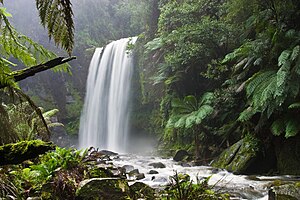 |
| Hopetoun Falls, Australia |
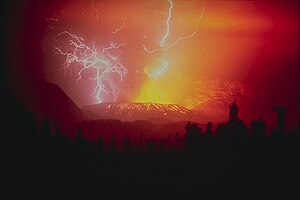 |
| Lightning strikes during the eruption of theGalunggung volcano, West Java, in 1982 |
Atmosphere, climate, and weather

The Earth's atmosphere is a key factor in sustaining the ecosystem. The thin layer of gases that envelops the Earth is held in place by gravity. Air is mostly nitrogen, oxygen, water vapor, with much smaller amounts of carbon dioxide, argon, etc. The atmospheric pressure declines steadily with altitude. The ozone layer plays an important role in depleting the amount of ultraviolet (UV) radiation that reaches the surface. As DNA is readily damaged by UV light, this serves to protect life at the surface. The atmosphere also retains heat during the night, thereby reducing the daily temperature extremes.
Terrestrial weather occurs almost exclusively in the lower part of the atmosphere, and serves as a convective system for redistributing heat. Ocean currents are another important factor in determining climate, particularly the major underwater thermohaline circulation which distributes heat energy from the equatorial oceans to the polar regions. These currents help to moderate the differences in temperature between winter and summer in the temperate zones. Also, without the redistributions of heat energy by the ocean currents and atmosphere, the tropics would be much hotter, and the polar regions much colder.

Weather can have both beneficial and harmful effects. Extremes in weather, such as tornadoesor hurricanes and cyclones, can expend large amounts of energy along their paths, and produce devastation. Surface vegetation has evolved a dependence on the seasonal variation of the weather, and sudden changes lasting only a few years can have a dramatic effect, both on the vegetation and on the animals which depend on its growth for their food.
Climate is a measure of the long-term trends in the weather. Various factors are known to influence the climate, including ocean currents, surface albedo, greenhouse gases, variations in the solar luminosity, and changes to the Earth's orbit. Based on historical records, the Earth is known to have undergone drastic climate changes in the past, including ice ages.

The climate of a region depends on a number of factors, especially latitude. A latitudinal band of the surface with similar climatic attributes forms a climate region. There are a number of such regions, ranging from the tropical climate at the equator to the polar climate in the northern and southern extremes. Weather is also influenced by the seasons, which result from the Earth's axis being tilted relative to its orbital plane. Thus, at any given time during the summer or winter, one part of the Earth is more directly exposed to the rays of the sun. This exposure alternates as the Earth revolves in its orbit. At any given time, regardless of season, the northern and southern hemispheres experience opposite seasons.
Weather is a chaotic system that is readily modified by small changes to the environment, so accurate weather forecasting is limited to only a few days.[citation needed] Overall, two things are happening worldwide: (1) temperature is increasing on the average; and (2) regional climates have been undergoing noticeable changes.
Ecosystems


Ecosystems are composed of a variety of abiotic and biotic components that function in an interrelated way. The structure and composition is determined by various environmental factors that are interrelated. Variations of these factors will initiate dynamic modifications to the ecosystem. Some of the more important components are: soil, atmosphere, radiation from the sun, water, and living organisms.

Central to the ecosystem concept is the idea that living organisms interact with every other element in their local environment. Eugene Odum, a founder of ecology, stated: "Any unit that includes all of the organisms (ie: the "community") in a given area interacting with the physical environment so that a flow of energy leads to clearly defined trophic structure, biotic diversity, and material cycles (i.e.: exchange of materials between living and nonliving parts) within the system is an ecosystem." Within the ecosystem, species are connected and dependent upon one another in the food chain, and exchange energy and matter between themselves as well as with their environment. The human ecosystem concept is grounded in the deconstruction of the human/nature dichotomy and the premise that all species are ecologically integrated with each other, as well as with the abiotic constituents of their biotope.[citation needed]
A smaller unit of size is called a microecosystem. For example, a microsystem can be a stone and all the life under it. A macroecosystem might involve a whole ecoregion, with its drainage basin.
Wilderness
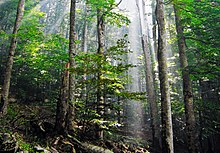 Wilderness is generally defined as areas that have not been significantly modified by human activity. Wilderness areas can be found in preserves, estates, farms, conservation preserves, ranches,national forests, national parks, and even in urban areas along rivers, gulches, or otherwise undeveloped areas. Wilderness areas and protected parks are considered important for the survival of certain species, ecological studies, conservation, solitude, and recreation. Some nature writers believe wilderness areas are vital for the human spirit and creativity and some Ecologists consider wilderness areas to be an integral part of the Earth's self-sustaining natural ecosystem (the biosphere). They may also preserve historic genetic traits and that they provide habitat for wild flora and fauna that may be difficult to recreate in zoos, arboretums, or laboratories.

Life

Although there is no universal agreement on the definition of life, scientists generally accept that the biological manifestation of life is characterized by organization, metabolism, growth, adaptation, and response to stimuli and reproduction. Life may also be said to be simply the characteristic state of organisms.
Properties common to terrestrial organisms (plants, animals, fungi, protists, archaea, and bacteria) are that they are cellular, carbon-and-water-based with complex organization, having a metabolism, a capacity to grow, respond to stimuli, and reproduce. An entity with these properties is generally considered life. However, not every definition of life considers all of these properties to be essential. Human-made analogs of life may also be considered to be life.
The biosphere is the part of Earth's outer shell – including land, surface rocks, water, air and the atmosphere – within which life occurs, and which biotic processes in turn alter or transform. From the broadest geophysiological point of view, the biosphere is the global ecological system integrating all living beings and their relationships, including their interaction with the elements of the lithosphere (rocks), hydrosphere (water), and atmosphere (air). The entire Earth contains over 75 billion tons (150 trillion pounds or about 6.8×10¹³ kilograms) of biomass (life), which lives within various environments within the biosphere.
Over nine-tenths of the total biomass on Earth is plant life, on which animal life depends very heavily for its existence. More than 2 million species of plant and animal life have been identified to date, and estimates of the actual number of existing species range from several million to well over 50 million. The number of individual species of life is constantly in some degree of flux, with new species appearing and others ceasing to exist on a continual basis.The total number of species is in rapid decline.
Plants and Animals

Originally Aristotle divided all living things between plants, which generally do not move fast enough for humans to notice, and animals. In Linnaeus' system, these became the kingdomsVegetabilia (later Plantae) and Animalia. Since then, it has become clear that the Plantae as originally defined included several unrelated groups, and the fungi and several groups of algaewere removed to new kingdoms. However, these are still often considered plants in many contexts. Bacterial life is sometimes included in flora, and some classifications use the termbacterial flora separately from plant flora.
Among the many ways of classifying plants are by regional floras, which, depending on the purpose of study, can also include fossil flora, remnants
of plant life from a previous era. People in many regions and countries take great pride in their individual arrays of characteristic flora, which can vary widely across the globe due to differences in climate and terrain.
of plant life from a previous era. People in many regions and countries take great pride in their individual arrays of characteristic flora, which can vary widely across the globe due to differences in climate and terrain.

Regional floras commonly are divided into categories such as native flora and agricultural and garden flora, the lastly mentioned of which are intentionally grown and cultivated. Some types of "native flora" actually have been introduced centuries ago by people migrating from one region or continent to another, and become an integral part of the native, or natural flora of the place to which they were introduced. This is an example of how human interaction with nature can blur the boundary of what is considered nature.
Another category of plant has historically been carved out for weeds. Though the term has fallen into disfavor among botanists as a formal way to categorize "useless" plants, the informal use of the word "weeds" to describe those plants that are deemed worthy of elimination is illustrative of the general tendency of people and societies to seek to alter or shape the course of nature. Similarly, animals are often categorized in ways such as domestic, farm animals, wild animals, pests, etc. according to their relationship to human life.
Animals as a category have several characteristics that generally set them apart from other living things. Animals are eukaryotic and usually multicellular (although see Myxozoa), which separates them from bacteria, archaea, and most protists. They are heterotrophic, generally digesting food in an internal chamber, which separates them from plants andalgae. They are also distinguished from plants, algae, and fungi by lacking cell walls.
With a few exceptions, most notably the sponges (Phylum Porifera), animals have bodies differentiated into separate tissues.[citation needed] These include muscles, which are able to contract and control locomotion, and a nervous system, which sends and processes signals. There is also typically an internal digestive chamber. The eukaryotic cells possessed by all animals are surrounded by a characteristic extracellular matrix composed of collagen and elastic glycoproteins. This may be calcified to form structures like shells, bones, and spicules, a framework upon which cells can move about and be reorganized during development and maturation, and which supports the complex anatomy required for mobility.
Human interrelationship

Although humans comprise only a minuscule proportion of the total living biomass on Earth, the human effect on nature is disproportionately large. Because of the extent of human influence, the boundaries between what humans regard as nature and "made environments" is not clear cut except at the extremes. Even at the extremes, the amount of natural environment that is free of discernible human influence is diminishing at an increasingly rapid pace.
The development of technology by the human race has allowed the greater exploitation of natural resources and has helped to alleviate some of the risk from natural hazards. In spite of this progress, however, the fate of human civilization remains closely linked to changes in the environment. There exists a highly complex feedback loop between the use of advanced technology and changes to the environment that are only slowly becoming understood. Man-made threats to the Earth's natural environment include pollution,deforestation, and disasters such as oil spills. Humans have contributed to the extinction of many plants and animals.
Humans employ nature for both leisure and economic activities. The acquisition of natural resources for industrial use remains the primary component of the world's economic system. Some activities, such as hunting and fishing, are used for both sustenance and leisure, often by different people. Agriculture was first adopted around the 9th millennium BCE. Ranging from food production to energy, nature influences economic wealth.
Although early humans gathered uncultivated plant materials for food and employed the medicinal properties of vegetation for healing, most modern human use of plants is through agriculture. The clearance of large tracts of land for crop growth has led to a significant reduction in the amount available of forestation and wetlands, resulting in the loss of habitat for many plant and animal species as well as increased erosion.
Aesthetics and beauty

Beauty in nature has historically been a prevalent theme in art and books, filling large sections of libraries and bookstores. That nature has been depicted and celebrated by so much art, photography, poetry, and other literature shows the strength with which many people associate nature and beauty. Reasons why this association exists, and what the association consists of, are studied by the branch of philosophy called aesthetics. Beyond certain basic characteristics that many philosophers agree about to explain what is seen as beautiful, the opinions are virtually endless.Nature and wildness have been important subjects in various eras of world history. An early tradition of landscape art began in China during theTang Dynasty (618–907). The tradition of representing nature as it is became one of the aims of Chinese painting and was a significant influence in Asian art.
Although natural wonders are celebrated in the Psalms and the Book of Job, wilderness portrayals in art became more prevalent in the 1800s, especially in the works of the Romantic movement. British artists John Constable and J. M. W. Turner turned their attention to capturing the beauty of the natural world in their paintings. Before that, paintings had been primarily of religious scenes or of human beings. William Wordsworth's poetry described the wonder of the natural world, which had formerly been viewed as a threatening place. Increasingly the valuing of nature became an aspect of Western culture. This artistic movement also coincided with the Transcendentalist movement in the Western world. A common classical idea of beautiful art involves the word mimesis, the imitation of nature. Also in the realm of ideas about beauty in nature is that the perfect is implied through perfect mathematical forms and more generally by patterns in nature. As David Rothenburg writes, "The beautiful is the root of science and the goal of art, the highest possibility that humanity can ever hope to see".
Natural history

Natural history is the research and study of organisms including animals, fungi and plants in their environment, leaning more towards observational than experimental methods of study. It encompasses scientific research but is not limited to it, with articles nowadays more often published in science magazines than in academic journals. Grouped among the natural sciences, natural history is the systematic study of any category of natural objects or organisms. That is a very broad designation in a world filled with many narrowly focused disciplines. So while natural history dates historically from studies in the ancient Greco-Roman world and the mediaeval Arabic world, through to European Renaissance naturalists working in near isolation, today's field is more of a cross discipline umbrella of many specialty sciences. For example, geobiology has a strong multi-disciplinary nature combining scientists and scientific knowledge of many specialty sciences.
A person who studies natural history is known as a naturalist or natural historian.


No comments:
Post a Comment